Clarifying Right View: Dharma Study in Zen
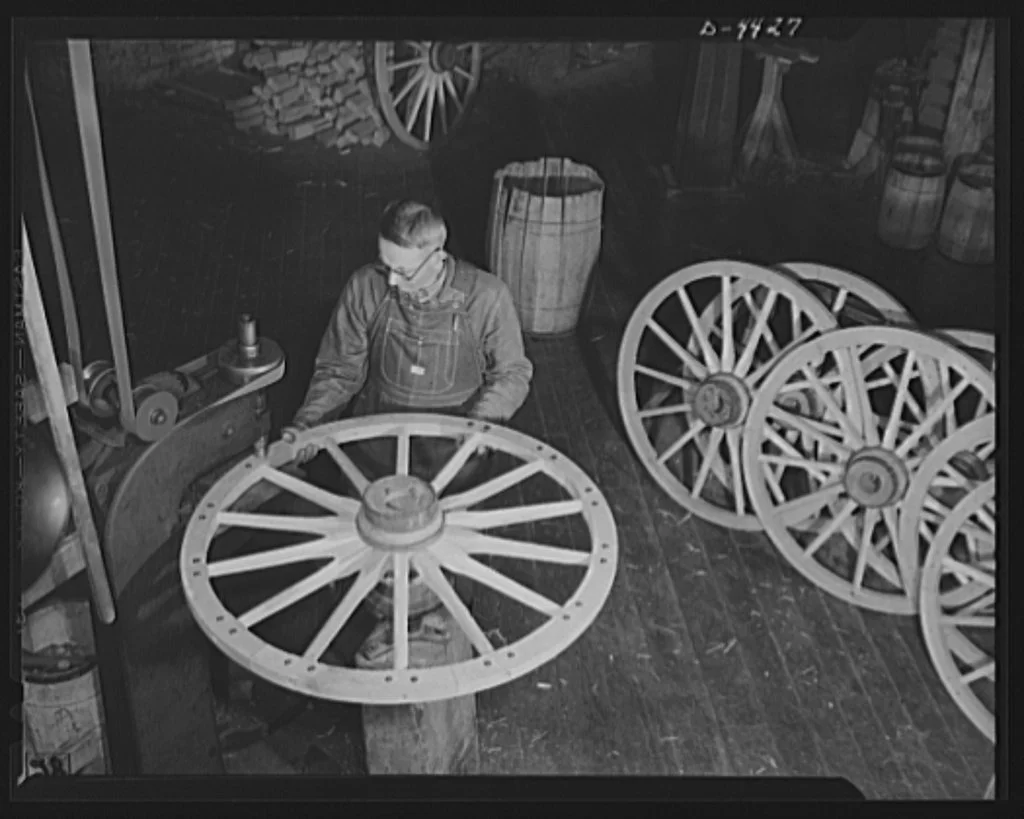
Howard R. Hollem, “Production. Wagon wheels. Revival of a dying art.”, 1942, Collection of the Library of Congress.
From the beginning, Zen has been known as a “separate transmission outside the scriptures, not based on written words, pointing directly to the human mind, seeing true nature and becoming buddha.” These words are attributed to Zen’s founder, Bodhidharma. Directly verifying our true nature and living in accord with this reality is the point of Zen practice. Though intellectual study of the words of the ancient realized ones is certainly not the same as their direct realization, some would say that it is virtually impossible to realize what they did without such thorough and far-reaching study, to unravel our most deeply held false assumptions.
In Dōgen Zenji’s Journal from China (Hōkyōki), his teacher Rujing said, “The great Way of the buddhas and ancestors has nothing to do with ‘inside or outside.’ Though Kashyapa Matanga (who brought the first sutras from India in the first century) and others had already transmitted the sutras to China previously, the reason Zen is called the ‘separate transmission outside the scriptures’ is because Bodhidharma came from the West and personally transmitted authentic practice. However, there aren’t two Buddha-Dharmas. Before Bodhidharma arrived in China there were practices, but no master to bring them to life. After Bodhidharma came to China it was like the people acquiring a strong king who brought the land, resources, and people of the kingdom under his sovereignty.” *
From ancient India up to today, there have been simple unlearned practitioners who have overwhelming devotion to their teachers, so that by just hearing a few words of pith instruction, or even being struck by a staff or a whisk, they were able to open to awakening in an instant. There have also been many others who didn’t have the disposition of overwhelming devotion, but who studied Dharma with their teachers for a long time, and were eventually able to open to awakening. Though verification of the Way is always the same in essence, there are different types of people with different dispositions. These days most practitioners don’t have such overwhelming devotion, so they need the reliable skillful means of Dharma study, combined with authentic zazen – sitting as “daily maintenance” but also immersion in frequent longer sesshins.
What kind of study is most essential for awakening? While Dharma study can be an important source of inspiration (such as reading the life stories of the ancestors) and has value in understanding the broader context of Buddha-Dharma, clarifying the view of ultimate reality has long been considered the most essential purpose of study. The view was originally taught in the Indian Mahayana Buddhist traditions of Madhyamaka (Middle-Way), Yogachara (Unity-Practice), and Tathagatagarbha (Buddha-Nature), and later taught in China, Korea, and Japan by the Zen ancestors. Authentic right view is not easy to stumble upon by chance, since it is so subtle and so contradictory to our usual human way of perceiving ourselves and the world. Various versions of the “view” have been creatively expressed, in a practical way, over many centuries by the Zen ancestors. For example, in early Chinese Chan, Guifeng Zongmi (780-841) systematically presented differing views of various Chan schools on the nature of mind and reality, to point out that if they are subtly misunderstood, this could lead to meditation practice that does not result in complete awakening and freedom. Zongmi’s teaching subtly clarifies the difference between various Chan schools in his time of the Tang Dynasty, and how their understanding may lead to either authentic complete awakening or subtly mistaken sidetracks.
Using metaphor to describe how mental afflictions and awakened mind can be understood, painted lacquer on a jewel represents different practice methods and their results. To briefly summarize Zongmi’s teachings on right view, he carefully distinguished four slightly different Chan views:
1. Northern School of Shenxiu: “real” mental afflictions (klesha) that obscure innate empty awareness, buddha-nature, must be removed gradually. This is like black paint on a clear radiant jewel that must be gradually polished away to see the jewel, an endless project.
2. Oxhead School of Farong: all afflictions are empty but emptiness is subtly grasped, and the pure luminous buddha-nature which manifests itself as awakened activity is not realized. This is like the clear jewel not existing at all, so it has no radiance.
3. Hongzhou School of Mazu: all appearances including afflictions are pure manifestations of buddha-nature, and complete awakening is nothing more than just realizing this. Thereafter, giving free rein to the mind, acting spontaneously and naturally, one need not cultivate wholesome and skillful qualities. This is like leaving the black paint on the jewel without changing anything, so its clear radiance is never seen.
4. Heze School of Shenhui: all appearances are pure manifestations of buddha-nature, innate empty unchanging awareness, which can skillfully manifest, adapting to conditions to benefit beings. Though this is realized suddenly, with gradual cultivation while abiding as empty awareness, one can progress through the bodhisattva path to buddhahood. This is like the black paint actually being just an illusory display of the clear radiant jewel, the pure black radiance being interfused with the clear jewel. According to Zongmi, this is the only truly authentic view and practice of Chan. There are many presentations of this view in Dōgen Zenji’s writings, though Dōgen himself never correlates them with the Heze School. **
In the Tibetan Dzogchen tradition, the practice is often described as clarifying the view (the most authentic understanding of mind and reality) – first conceptually through hearing or study, then experientially by having it directly pointed out by a realized teacher. Once right view has been recognized, then the meditation practice is simply to “maintain the view” – in formal meditation and throughout the day. The same could be said of the Zen tradition as well, where the classic texts give very little practical meditation instructions, but thousands of pages clarifying the view through direct pointing, encounter dialogs, etc. For example, Sōtō Zen ancestor Shitou Xiqian (Sekitō Kisen, 700-790) once said, “Our Dharma gate has been transmitted by the ancient buddhas; without recourse to meditative concentration or effort, one arrives at the awareness and vision of a buddha: mind itself is buddha; mind, buddha, sentient being, awakening, affliction, are all different names for the same thing. You must realize that the essence of your own mind is neither finite nor eternal, its nature is neither defiled nor pure. It is still and complete, the same in ordinary people and sages. It responds freely, apart from mind, intellect, and dualistic consciousness. The three realms and the six types of beings are only manifestations of mind. How can the moon reflected in water, or images reflected in a mirror, originate or cease to be? If you can understand this, there is nothing you lack.” Note how Shitou’s view here sounds quite similar to the authentic Heze School, as presented by Zongmi above: “The three realms and the six types of beings” as we usually perceive them are like the black paint actually being just an illusory display of the clear radiant jewel.
Dōgen’s “Universal Encouragement for Zazen” (Fukanzazengi) begins: “The Way is originally perfect and all-pervading – how could it depend on practice-and-verification?” Later in the treatise he offers some practical methods for arranging the posture and breathing, but it could be understood that the essential practice of zazen is simply maintaining the view that was presented in the first sentence.
Without first clarifying the view, strictly speaking, it is impossible to sit true zazen as the practice-and-verification of buddha’s mind. Without the view, zazen, in the best case, ends up as mere shamatha (calm-abiding) – an excellent practice, but not the vipashyana (direct insight) which liberates the mind from the painful cycle of birth-and-death. Prajna (wisdom), a near-equivalent to vipashyana, is traditionally taught as being of three types, realized progressively: wisdom from hearing or studying the teachings, wisdom from contemplating the teachings and applying them to our own experience, and wisdom from directly becoming the teachings beyond all conceptual and dualistic thoughts. Without first deeply studying the precious teachings, we won’t know which direction our practice is going; without deeply contemplating them in an experiential but still conceptual way, we won’t know whether they are really true or not; without directly becoming them in zazen, we won’t taste the truth of the Tathagata’s words beyond all doubt. Therefore, Dharma study is never for the sake of merely accumulating a bunch of conceptual knowledge, though of course that can be satisfying for a sentient being.
Having said all this, the Zen tradition has many warnings about getting caught up trying to get direct verification from written Dharma words. In Case 53 of the Book of Serenity, Huangbo (Ōbaku, d. 850) said to the assembly, “You people are all dreg-slurpers (drinking the dregs of the ancestors’ words). If you go on like this, how will you have today? Don’t you know that in all of China there are no teachers of Zen?” At that time a monk came forward and said, “What about those who guide students and lead groups in various places?” Huangbo said, “I don't say that there’s no Zen, just that there are no teachers.”
In Wansong’s commentary on this case, he brings up a story from the Daoist classic of Zhuangzi. Once Lord Ji Heng was reading a book in his upstairs room: Wheelwright Pian was making a wheel outside; he put aside his mallet and chisel, came up and asked, “May I ask what you are reading, sir?” The lord said, “A book of the sages.” Pian said, “Are those sages alive?” The lord said, “They are already dead.” Pian said, “Then what you are reading is the dregs of the ancients.” The lord said, “When a monarch reads a book, how can a wheelwright discuss it? If you have an explanation, all right; if not, then you die.” Pian said, “I look upon this in light of my own work. When I plane a wheel, if I go too slowly and gently, the action is not firm; if I go too quickly and violently, it is hard and doesn’t go in. Not going slowly or quickly, I find it in my hands and accord with it in my mind, but my mouth can’t express it in words. There is an art or knack to it, but I can't teach it to my son, and my son can’t learn it from me. Therefore, I have been at it for seventy years, grown old making wheels. The people of old and that which they couldn’t transmit have died. Therefore, what you are reading, sir, is the dregs of the ancients.”
In Dōgen’s Shōbōgenzō Zuimonki (True Dharma Eye Treasury, Record of Things Heard), he gives various admonitions to the assembly, in the spirit of Huangbo and Wheelwright Pian, sometimes to study Dharma and sometimes to not study Dharma. For example, in section 2.8 Dōgen says: “Those who study the Way should not read the sutras of the teaching-schools, nor study non-Buddhist texts. If you want to study, read the recorded sayings of Zen ancestors, and put away all other texts for now.” Then, going even further in section 2.9 he says: “Learning the way of the ancient teachers by reading their recorded sayings in order to teach them to others is ultimately not useful for my own practice or for teaching others. Even if I don’t know a single letter of Dharma, I will be able to demonstrate it to others in infinite ways if I devote my life to just sitting and resolving the great matter.” And in section 2.11: “Wayfarers who truly devote their lives to practice should not read even the recorded sayings of the Zen ancestors. Since this is so, there’s no need to mention the uselessness of other types of study.” Of course, Dōgen himself later in his life, wrote many hundreds of pages of essays commenting on the Zen ancestors’ sayings, which he must have intended his students to read.
Later, in section 4.8 of Zuimonki, Dōgen contradicts his previous admonition against study, at least for beginnners, saying: “Beginning students of the Way, whether you have aroused the aspiration for awakening or not, you should thoroughly study the sutras and shastras.” And in section 5.15 he says: “Even if you feel you have understood the sacred sutras, study them again and again. Also listen to your teacher’s words again and again, even though you may have heard the teachings before. In this way, you will find deeper and deeper meaning.”
And finally, in section 5.23, Dōgen says: “Even if you seem to have some understanding while studying Zen kōans, such studies will remove you from the Way of the buddhas and ancestors. To spend your time sitting upright with nothing to be gained and nothing to be realized is the Way of the ancestors. Although the ancient teachers promoted both Dharma study and just sitting, they mostly emphasized diligent sitting. Though some have realized awakening when hearing stories of the ancestors, the awakening was because of the merit of sitting.”
On the other hand, Dōgen Zenji wrote in “Painting of a Rice Cake” (Shōbōgenzō Gabyō): “An ancient buddha said that a painting of a rice cake does not satisfy hunger... However, to think this statement means that skillful teachings are useless is a great mistake... There is no remedy for satisfying hunger other than paintings of rice cakes. Without painted hunger you never become a true person.”
As the wheelwright said, “Not going slowly or quickly, I find it in my hands and accord with it in my mind, but my mouth can’t express it in words. There is an art or knack to it.” Could this be received as a hidden instruction for how to study Dharma in accord with the Way? We may be able to read a sutra as nothing other than a manifestation of our true self.
In Dōgen’s “Self-Verification Samadhi” (Shōbōgenzō Jishō Zammai) he wrote: “What has been authentically transmitted by all buddhas, including the seven ancient buddhas, is self-verification samadhi. For this it is necessary to follow a teacher or follow a sutra. This is the eyeball of the buddhas and ancestors… There are words that clearly affirm and words that completely deny. Meeting these words and studying them with the whole body and mind, however many eons are exhausted, and however many eons are taken up, there is always the place of arriving at full mastery… Follow and study the sutras. Even if you try to avoid them and not follow them, this is impossible. Since this is so, the sutras become the eye and marrow… Thus, both following a teacher and following a sutra are following the self. A sutra is no other than a sutra as the self. A teacher is always a teacher as the self. Thus, to meet with teachers all over is to meet with the self all over.”
In Dōgen’s monastery Eiheiji, during his time, there was a study hall (shuryō) equipped with individual reading desks. Dōgen wrote, “In the study hall, read the Mahayana sutras and the records of the Zen ancestors; in this way you can accord with our tradition of illuminating the mind with the ancient teachings.” At Tassajara Zen Monastery, there is a Dharma study period in the daily schedule during the 90-day ango. On the other hand, at Bukkokuji Zen Monastery in Japan, where I practiced with Tangen Harada Rōshi, the resident sangha was not allowed to study any Dharma, much less read the newspaper. The temple guideline was to not read any print smaller than a street sign – thus, on the rare occasion when someone went into town, he could find his way around. Tangen Rōshi, who had practiced this way himself in his early monastic days, said that anyone who made it to Bukkokuji to practice must have already heard enough Dharma and now just needed to put it into practice wholeheartedly. Understanding Dharma was still important, but in such a case, it only needed to come through the living teacher.
In my own case, I was very drawn to Dharma study from the beginning, with a strong intention to study everything about Buddha-Dharma and especially Sōtō Zen. After a few years of reading many sutras and Zen texts, and a year at Bukkokuji where I heard of the practice of refraining from reading, I asked my teacher if I should go on a reading “fast” for some months or years. He discouraged me from such a fast, and when I look back now, I feel that this was good advice. Over the years of deepening Dharma study, I came to learn that my earlier views were not so clear and accurate, and as my understanding deepened my zazen practice deepened accordingly. Dharma study is endless, and thus the depth of practice-and-verification during zazen is endless.
May all those who encounter the teachings of the buddhas and Zen ancestors be filled with boundless freedom and joy, finding no edges in the vast ocean of eternal brightness.
***
* All quotations in this text are the translations of the author, Kōkyō Henkel. You can visit his website here.
** These various Chan views may also be loosely correlated with the Indian Mahayana tenet systems mentioned above. It would be a beneficial study project to make a contemporary survey of modern Zen views regarding the nature of mind, reality, and authentic meditation practice – and see how these compare to the views of our ancient ancestors who completed their lives’ work of practicing-and-verifying the Way and leaving us their liberating records. See Jeffrey Broughton, Zongmi on Chan, Columbia University Press, c. 2009, and Robert Buswell, Numinous Awareness is Never Dark, University of Hawaii Press, c. 2016 for details of Zongmi’s views.