Mother Tiger: Suzuki Roshi on Study and the Original Way of Zen
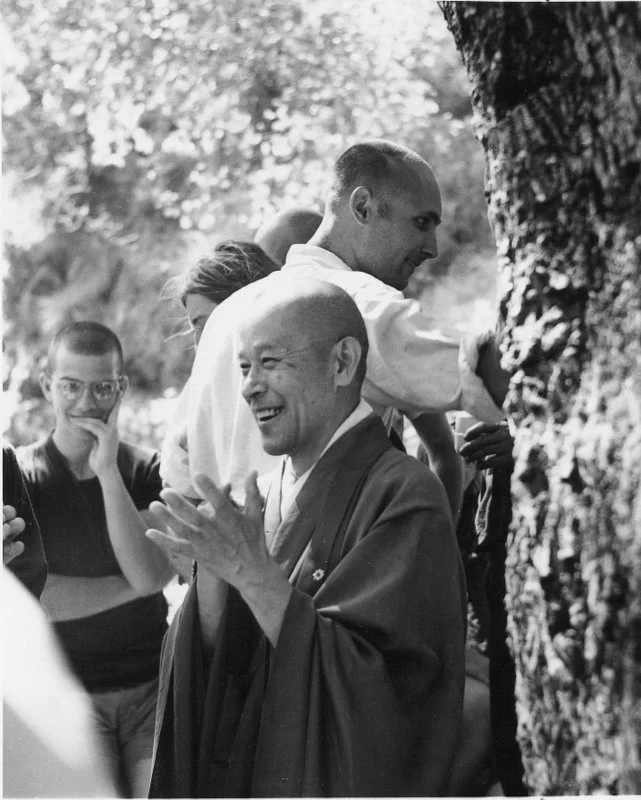
1969, Shunryu Suzuki with students at Tassajara summer training session, by Alan Marlowe. From the photo archive at cuke.com
It is probably impossible to overstate the impact of Shunryu Suzuki on Zen in the west. In his twelve short years in San Francisco before his untimely death from cancer, in 1971, San Francisco Zen Center was founded, followed five years later by Tassajara, the first Zen training monastery in the west, and finally the publication of the much-loved and ever-popular Zen Mind, Beginner's Mind.
Like many of the teachers who came from Japan to the west during the last century, he can be seen as something of a maverick, more interested in re-establishing the primacy of zazen as the fundamental practice than in fulfilling the ritualistic formal ceremonial roles of a Japanese temple priest. While he was invited to San Francisco precisely to minister to the Japanese community in this way, from his earliest days in California he went to speak at many different venues, and his suggestion to the young seekers who flocked to San Francisco in the late fifties and sixties was always the same: I sit zazen every morning, you are welcome to join me.
It is thought that Suzuki Roshi gave around four hundred talks in those twelve years. The first ones were transcribed or summarised, and published in Zen Center's periodical Wind Bell from 1962 onwards. Most of the earliest talks are his commentary on the Blue Cliff Record. This was one of the few texts available in English at the time, along with Zen Flesh, Zen Bones, so he did not have to struggle to translate each case and his students could follow along. It is also possible that Suzuki Roshi felt that his students might have felt these traditional koan stories, with their logic-crushing exchanges, matched their ideas about Zen.
Audio recordings were first made in 1965, about the time that Suzuki Roshi was also beginning to visit outlying groups in Berkeley and Stanford. This latter group moved to Los Altos, and recordings made by Marian Derby at the sittings in her house became the basis for Zen Mind Beginner's Mind. Interestingly, the focus of the talks was shifting at this time. There were several explaining the Prajna Paramita Sutra, which was the only thing chanted, in Japanese, at every service at Zen Center and elsewhere; and also the appearance of references to the Shobogenzo, and Eihei Dogen, the Japanese founder of Soto Zen.
There are two possible prompts for this shift at this time. The first, at least according to this interview by Suzuki Roshi disciple David Chadwick - who has done more than anyone to preserve his teacher's work - was a visit from scholar and artist Kaz Tanahashi, who suggested that Suzuki Roshi needed to be giving “the best” that Soto Zen had to offer. There was also the presence of Reiho Masunaga, who had published a book in English called The Soto Approach to Zen in 1963, which included a translation of Dogen's earliest writing, the Fukanzazengi. Masunaga visited Zen Center in 1965, and was beginning a translation of the entire Shobogenzo; he contributed an article on Dogen to a Wind Bell around this time, right before Suzuki Roshi began an extended series of lectures on Dogen’s Genjo Koan in the first half of 1966.
Suzuki Roshi had studied with one of Japan's leading Dogen scholars, Kishizawa Ian, for an extended period of time, and perhaps because of this, many of the talks in Zen Mind Beginner's Mind, and elsewhere in the archive, even if they are not explicitly about Dogen, are wonderfully accessible paraphrases of Dogen's understanding. As has been pointed out there was no established vocabulary for Zen in English such as had evolved in Japan, and Suzuki Roshi, speaking in his second language (albeit one he had studied and been interested in for decades) used those very limitations to create a distinctive new language.
A paragraph from a recently re-discovered talk during a 1966 one-day sitting at Sokoji, where Zen Center was based at the time, perhaps showcases Suzuki Roshi's approach as well as anything:
So, for your teacher, there is not much things to tell you, actually. As a mother tiger doesn't have so many things to teach for her children. To live with their children is how to teach [laughs]. Actually there is not much things to tell you. So with beginner's mind, if you walk [laughs] like your teacher walks, that is the way how to study Buddhism. And for a teacher, try to be a good teacher [laughs] is how to teach Buddhism. That's all. It is very difficult [laughs] for a teacher to be example of (for) student, and this is impossible. At least for me it is absolutely impossible [laughter]. But if I try very hard to be a good friend of you, within my ability, I think there is no other way for us to study Buddhism. So beginner's mind is very important. Just to practice zazen as your teacher, that is the only way. If you have some doubt on this point, you should read Shobogenzo - ninety-five volumes of Shobogenzo - over and over again [laughs]. Then you will find out how important the beginner's mind is. I think we are lucky to have so many friends in this zendo, and practice zazen with some unusual comprehension of our practice. Thank you very much. (March 26, 1966, link here.)
He is in turns self-deprecating, teasing (suggesting his students read the entire Shobogenzo to discover the importance of beginner’s mind), and encouraging.
This paragraph also illuminates his approach to study. His students’ natural tendencies towards intellectualising, striving to understand, and having some notion about how to get enlightened - which we can hear in many recordings that feature their questions - are met by Suzuki Roshi carefully nudging them away from relying on such notions, and instead focusing primarily on the practice and the insights that this offered:
I felt something even blasphemous when they talk about how Buddhism is perfect as a philosophy or teaching without actually knowing what it is. To practice zazen in this way, with group, is the most important thing for Buddhism and for us. There is nothing so important than this practice for us because this practice is the original way of life. (October, 1965, link here.)
As the practice community at Sokoji grew and became a little more stable, sitting together most days and all day once a month, he emphasised that the community was not dependent on any kind of syllabus or course of study:
I am trying to be more sympathetic and systematic in my answers, because you will not understand what I am trying to say if my answer is not properly systematized. But for me, and for you too, systematic philosophical answer will not be necessary, but the mutual understanding and friendship between us is more important. What we do looks like very rigid and formal, but if you repeat this kind of practice over and over, you will find out some unique feeling, in our rituals and formalities. (March 1966, link here.)
Establishing the monastery at Tassajara in the summer of 1967 offered his students the chance to study with him in the kind of way outlined above, and was perhaps the culmination of Suzuki Roshi’s desire to transmit the authentic way of Zen. His talks in the first few months of training underline his views on what he felt were the most important elements:
It is much easier to listen to your teacher than to read some books, because as long as he is telling you something, he is believing in it. So that communication through belief will result in tremendous impact here. So this is not just intellectual study, and this is also emotional study, and the study with your mind and body. That is why it is better to study with your teacher. This the difference between just reading and practicing something here. If practice is so important, there must be a teacher. And if there is a teacher, you should not be concerned about just intellectual understanding or criticism or discrimination. (August 1967, link here.)
He wanted his students to be versed in Buddhist texts, for sure, but never to substitute that kind of learning for the deep learning they were getting from just following the monastic schedule:
If we want to know the meaning of Zen, it is necessary for you to study Buddhist teaching. But, whether or not you study Buddhist teaching, if you practice our way, there is the direct experience of the teaching. And, that is at the same time, the application of teaching through your everyday life. So in this sense, zazen practice is not just to cross your legs, and sitting in some certain posture. And it is also your everyday life -- your activity in your everyday life. Whatever you do, that -- that activity should be Zen. (September 1967, link here.)
Monastic training - or any kind of Zen practice - is never hermetic. While zazen offers the opportunity to touch a place beyond dualities and ideas of self, its value only becomes real when we can take what we learn, through our minds and bodies, into the world as a Bodhisattva, to be of benefit to all beings. Suzuki Roshi is not revered for his intellectual prowess, for all his deep understanding; he was loved because his young, seeking students felt seen and met by him.
…our practice is not the practice to having some lofty teaching in our mind, and to dwell on this kind of understanding, and to improve our state of mind is not, you know, our way.
If Zen is a practice for just men, or for just learned scholars, or for just man of great spiritual ability, Zen will not help people. Actually in Japan, Soto Zen, who put emphasis on our everyday life, not only zazen practice but also everyday life, thinking everyday life is a kind of Zen practice.
Zen school established without depending on any teaching, any particular teaching. So Zen student use various scriptures, you know. We do not say this is the most important scripture or this is not so important. We do not say that. Whatever the teaching may be, that teaching will help at least someone. (July 1968, link here.)
By Shundo David Haye